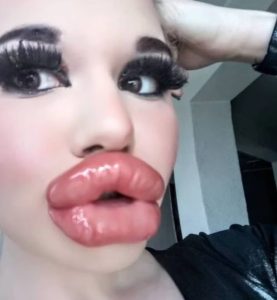
Andrea Ivanova’s story is one that immediately captures attention, not only because of her appearance but because of the determination behind it. Known internationally as the woman with the “world’s biggest lips,” the Bulgarian influencer has never hidden her intentions. Her transformation journey began in 2018, rooted in a desire to reshape herself into what she considers an ideal form inspired by the exaggerated aesthetics of Bratz dolls. At the time, her decision was viewed by many as shocking, unnecessary, or even reckless. Yet for Andrea, it represented something deeply personal: the freedom to design her own body without asking permission. Over the years, her face has changed dramatically through repeated cosmetic procedures, including extensive filler injections to her lips, chin, jawline, and surrounding facial structures. Each alteration marked another step toward a look that defied conventional beauty norms and pushed the boundaries of what cosmetic medicine typically accommodates. What started as a personal experiment soon evolved into a public spectacle, drawing fascination, criticism, admiration, and concern from audiences around the world. Andrea did not retreat from the attention; instead, she embraced it, using social media as both a platform for self-expression and a stage where her evolving image could be seen, discussed, and debated endlessly.
As her online presence grew, so did her notoriety. Andrea’s social media accounts became visual timelines of transformation, with followers tracking subtle and dramatic changes alike. Thousands tuned in not merely to see her latest look, but to understand the mindset behind her decisions. To some, she became a symbol of radical self-ownership, someone unafraid to challenge societal expectations of femininity and attractiveness. To others, she represented the darker side of influencer culture, where extreme visuals translate into engagement, and engagement can incentivize pushing physical limits. Financially, her commitment has been substantial, with reports indicating that she has spent a significant amount of money on fillers and procedures over several years. Yet Andrea rarely frames this as a sacrifice. Instead, she speaks of it as an investment in herself and her identity. In her view, her appearance is not a mistake or a cry for attention, but a carefully curated expression of who she wants to be. This philosophy has resonated with a segment of her audience that values autonomy above conformity, even when that autonomy leads to outcomes others find uncomfortable or alarming.
The recent revelation of her new mission—to achieve what she describes as the world’s largest cheekbones—has reignited intense discussion. For Andrea, this next goal is a natural continuation rather than a drastic escalation. She sees her face as an evolving project, not a finished product. Cheekbones, in her perspective, are another defining feature that can enhance the doll-like aesthetic she has been pursuing for years. However, this announcement has amplified concerns among medical professionals and critics alike. Several doctors have publicly cautioned against further filler use, especially at the scale Andrea is pursuing. They warn of potential complications such as tissue damage, infections, impaired blood flow, and long-term facial deformation that may not be reversible. These warnings are not abstract; cosmetic medicine carries real risks, particularly when procedures are repeated frequently or pushed beyond typical guidelines. Andrea, however, remains resolute. She acknowledges the warnings but insists that she is informed, conscious of the risks, and willing to accept the consequences in pursuit of her vision. For her, external concern does not outweigh internal satisfaction.
This tension between medical caution and personal choice lies at the heart of the controversy surrounding Andrea Ivanova. On one side are professionals trained to prioritize patient safety, ethical limits, and long-term health outcomes. On the other is an individual asserting bodily autonomy as an absolute right. Andrea often emphasizes that she is an adult making voluntary decisions about her own body, not someone being coerced or misled. She rejects the notion that her appearance is inherently harmful or that it must align with medical or societal comfort zones. In interviews and online statements, she has repeatedly stressed that no one has the authority to dictate how she should look. This stance has turned her into a lightning rod in broader conversations about consent, responsibility, and the role of cosmetic practitioners. Should doctors refuse procedures they believe are excessive, even if a patient insists? Where is the line between respecting autonomy and preventing harm? Andrea’s case does not offer easy answers, but it forces these questions into public view, where they are debated far beyond clinic walls.
Beyond medicine, Andrea’s transformation also highlights the powerful influence of social media in shaping modern identity. Platforms reward visibility, uniqueness, and shock value, often blurring the line between authentic self-expression and performative extremes. Andrea’s appearance guarantees attention, which in turn sustains her relevance in an increasingly crowded digital landscape. Critics argue that this creates a feedback loop, where dramatic changes are reinforced by likes, comments, and media coverage. Supporters counter that attention does not invalidate sincerity, and that assuming her motivations are purely algorithm-driven oversimplifies a complex personal journey. Andrea herself rarely frames her choices in terms of audience reaction. She presents them as deeply personal desires that existed before fame and would continue regardless of public response. Still, the reality remains that her transformation unfolds in public, and each new step becomes content consumed, shared, and judged by strangers across the globe.
Ultimately, Andrea Ivanova’s new mission is about more than cheekbones or records; it is about control, identity, and the right to self-definition in a world that constantly polices appearance. Whether viewed as empowering or troubling, her journey challenges comfortable assumptions about beauty, limits, and normalcy. She stands as a reminder that personal freedom can be unsettling when it defies collective standards. As she continues to pursue her evolving vision, the debates surrounding her will likely intensify, touching on ethics, health, media responsibility, and the psychology of transformation. Andrea appears unfazed by the noise. For her, satisfaction comes not from approval, but from alignment with her own ideals. In that sense, her story is less about the size of her lips or cheekbones and more about the enduring human desire to shape one’s own image, even when that choice unsettles the world watching.