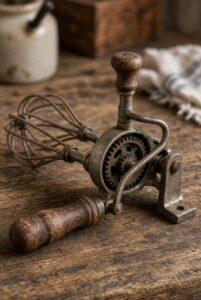
In the heart of every old-fashioned kitchen, long before electric mixers hummed on countertops, sat a humble yet ingenious tool that transformed everyday baking into a labor of love. The vintage hand-cranked rotary egg beater, with its wooden handles, interlocking metal gears, and wire whisks, remains one of those objects that instantly sparks recognition among older generations. Anyone who grew up watching a parent or grandparent whip egg whites into stiff peaks or blend cake batter by hand will know exactly what this is. Its simple mechanical design required only a steady turn of the crank, producing a rhythmic whir that filled the kitchen with the promise of fresh biscuits, fluffy omelets, or Sunday morning pancakes.
This classic tool dates back to the late 19th and early 20th centuries, when inventors sought practical ways to ease the physical effort of cooking. Early models featured sturdy cast-iron or tin bodies and carefully engineered gears that multiplied the force of each rotation. By the 1940s through the 1960s, these beaters had become standard equipment in American and European households. Families relied on them daily, and the slight resistance felt in the handle taught children the value of patience and effort. Unlike modern appliances that demand electricity and produce uniform results at the push of a button, the rotary beater demanded presence and attention, turning cooking into a shared, tactile experience.
Many elderly people still smile when they see one resting on a rustic wooden table, its wooden grips worn smooth by decades of use and its metal parts showing the gentle patina of age. They remember the sound of the gears clicking, the way the whisks spun faster with each turn, and the satisfaction of watching cream thicken or egg whites rise. These memories are more than nostalgia; they represent a time when kitchens were centers of family life rather than places of convenience. The tool itself often passed from one generation to the next, carrying stories of holiday baking, birthday cakes, and everyday meals prepared with care.
Today, vintage egg beaters have found new life among collectors, antique enthusiasts, and home cooks who appreciate slow living. Restored models appear in farmhouse kitchens and museum displays, while modern replicas pay quiet homage to the original design. Their enduring appeal lies in the reminder that good food does not always require the latest technology. A few minutes of steady cranking can still produce results that rival any electric mixer, and the process itself feels grounding and purposeful.
In an age of smart appliances and instant results, the old rotary egg beater stands as a quiet testament to ingenuity and tradition. It invites us to slow down, to use our hands, and to reconnect with the simple pleasures that once defined home cooking. For those who recognize it at a glance, it is far more than a kitchen tool—it is a cherished piece of living history that continues to whisk up warm memories with every turn of the crank.