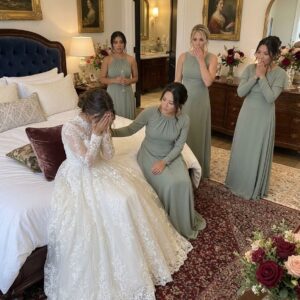
I stood there holding the phone, staring at the wedding check on the counter as if the number might somehow change. Sixty-three thousand dollars. I had paid it because Amanda was my daughter, because Catherine would have wanted her to have everything she dreamed of, and because I never imagined that paying for her wedding would eventually make me feel like a stranger in her life. “I understand,” I finally said. “Have a beautiful rehearsal dinner.” Amanda sounded relieved. “Thanks, Dad. I knew you’d understand.” I hung up without telling her what I was thinking. That night, I canceled nothing. I simply opened a folder containing every wedding expense and placed it beside Catherine’s photograph.
For the next week, I stayed out of the wedding planning. I didn’t complain, didn’t call, and didn’t ask why Aunt Diane had apparently become more important than me. Then, exactly seven days before the wedding, Amanda called. Her voice was completely different. “Dad, there’s one thing. We’re trying to finalize the honeymoon account. Derek said you were transferring another fifteen thousand dollars for the trip. Did you do that?” I looked at the folder on my desk. “Didn’t I tell you?” There was silence. “Tell me what?” she asked. “I thought we were keeping financial matters limited to immediate family.” She immediately became defensive. “Dad, that’s not fair. The honeymoon is important.” “So was the rehearsal dinner,” I replied. She stopped talking.
That afternoon, Derek came to my house. He arrived without Amanda and immediately began explaining why I had misunderstood everything. He said the rehearsal dinner had been about space, that the honeymoon money had always been part of the wedding budget, and that everyone was stressed. I listened until he finished. Then I opened my folder and showed him the receipts. Venue: $24,800. Catering: $12,600. Photography: $5,400. Flowers: $4,100. Music, transportation, decorations, deposits and everything else brought the total to $63,000. “I paid for the wedding,” I said. “I didn’t agree to finance your marriage indefinitely.” Derek’s face tightened. “Amanda’s going to be devastated.” I nodded. “So was I.”
On Saturday morning, I attended the wedding. I wore the suit Catherine had bought me before she became ill. When the doors opened, Amanda walked down the aisle beside Aunt Diane and Derek’s father. I remained seated. I didn’t make a scene. I simply watched my daughter marry the man she had chosen. After the ceremony, Amanda approached me with tears in her eyes. “Dad, I’m sorry.” I asked her one question. “If I hadn’t paid for the wedding, would you still have wanted me here?” She couldn’t answer immediately. Finally, she whispered, “Yes.” I smiled sadly. “Then you should have treated me like your father before you needed another check.”
Three months later, Amanda came to my house alone. She told me the marriage was struggling because Derek had expected me to keep solving their financial problems. She also admitted something that hurt more than the money ever had: she had let other people convince her that my value to her family was connected to what I could provide. I told her I would always be her father, but I would no longer purchase a place in her life. She cried, and this time I hugged her without reaching for my wallet. Before she left, she noticed Catherine’s photograph on the mantel. “Mom would be proud of you,” she said. I looked at the picture and smiled. “I hope so.” And for the first time since the wedding planning began, I felt that I had finally honored both my wife and myself.