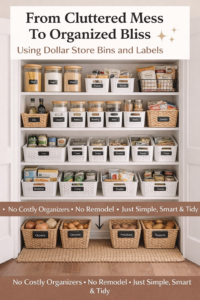
For many women, especially those who have spent decades caring for families, managing households, and adapting to constant change, the pantry quietly becomes one of the most overlooked spaces in the home. It starts innocently enough: an extra bag of rice placed on a shelf, a few cans stacked in front of older ones, a box of pasta tucked wherever it fits. Over the years, convenience takes priority over intention, and the pantry slowly turns into a source of daily frustration. Items are purchased twice because they cannot be found. Shelves feel crowded yet somehow empty at the same time. The simple act of preparing a meal becomes more stressful than it should be. What many women do not realize is that this clutter is not a personal failure, nor is it a sign that they need expensive solutions. It is simply the natural result of life moving faster than our systems. When one woman decided to address this quietly nagging problem with nothing more than a few dollar store bins and a clear plan, she unintentionally sparked a movement that resonated deeply with women over fifty-five who recognized themselves in her story.
The beauty of her approach lay in its simplicity. Instead of chasing trendy organizers or redesigning the space entirely, she started by emptying the pantry completely and giving herself permission to begin again. This step alone felt liberating. With everything visible, patterns emerged: duplicate items, expired goods, and shelves that had never truly been optimized for daily use. She grouped similar items together, not according to aesthetics but according to how she actually cooked and lived. Baking supplies went near the counter where she kneaded dough. Breakfast items were placed at eye level for easy mornings. Snacks were contained neatly so they could be seen at a glance. The dollar store bins were not chosen because they were cheap, but because they were lightweight, uniform, and flexible. They created structure without rigidity. Labels added clarity without judgment. Suddenly, every item had a home, and the pantry stopped feeling like a chaotic storage closet and started functioning as a supportive part of the kitchen.
What struck so many women watching this transformation was how achievable it felt. There was no sense of being talked down to or sold a fantasy. This was not a twenty-something influencer chasing perfection; it was a woman who understood real kitchens, real budgets, and real lives. For women over fifty-five, many of whom are downsizing, simplifying, or simply craving less visual noise, this kind of transformation speaks directly to deeper desires. A tidy pantry is not about impressing guests. It is about peace of mind. It is about opening a door and feeling calm instead of overwhelmed. It is about knowing what you have, using what you buy, and reducing waste without effort. The emotional response to this kind of order is profound. It restores a sense of control and competence at a stage of life where priorities shift from accumulation to intention.
As photos of the finished pantry circulated, comments poured in from women who felt seen. They shared stories of decades-old kitchens, inherited habits, and the quiet stress of clutter that had gone unaddressed for years. Many admitted they had assumed organization was a young person’s game or something that required physical energy and money they no longer wanted to spend. Seeing someone their age succeed with such modest tools challenged those assumptions. The pantry makeover became less about storage and more about mindset. It encouraged women to believe that improvement does not have to be dramatic to be meaningful. A few hours, a small budget, and a willingness to rethink habits were enough to create a noticeable shift in daily life.
Beyond the immediate visual satisfaction, the long-term benefits became clear. Meals became easier to plan because ingredients were visible and accessible. Grocery shopping grew more intentional, reducing impulse buys and forgotten items. Cleaning took less time because shelves were no longer overcrowded. Perhaps most importantly, the pantry stopped being a reminder of unfinished tasks and became a quiet success story within the home. For women navigating retirement, changing family dynamics, or simply redefining what comfort means, these small victories matter. They reinforce the idea that the home can evolve alongside its owner, adapting to current needs rather than clinging to past routines.
This simple pantry transformation ultimately resonated because it respected experience instead of ignoring it. It did not suggest starting over in life, only starting fresh in one small space. For women over fifty-five, that message carries weight. It acknowledges years of knowledge while offering permission to do things differently now. The dollar store bins were merely tools; the real change came from reclaiming intention. In a world that constantly pushes bigger, newer, and more expensive solutions, this story reminded thousands of women that clarity, calm, and beauty are often found in the simplest choices. And sometimes, all it takes to spark that change is one organized shelf, one labeled bin, and the quiet realization that it is never too late to make your home work better for you.