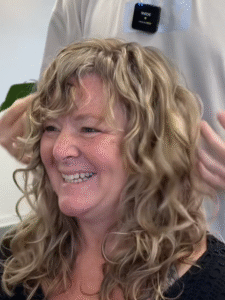
Curly hair has always carried a presence that cannot be ignored. Spirals, coils, and waves announce themselves before a word is spoken, yet for generations this visibility was framed as a problem rather than a gift. Many people grew up hearing that their hair was too wild, too unprofessional, too difficult, or simply too much. Schoolyards echoed with teasing comments, mirrors reflected frustration, and beauty standards quietly but persistently suggested that smoothness equaled acceptability. Straightening became a ritual performed before sunrise, accompanied by the smell of heat and chemicals and the promise of fitting in for just one more day. Over time, damage accumulated not only on the strands themselves but also in the way people saw their own reflection. What should have been an expression of identity became a daily negotiation with shame, convenience, and survival in environments that rewarded conformity. This long history explains why the decision to stop straightening is rarely superficial. It is often the result of exhaustion, curiosity, or a sudden realization that constant correction comes at a high emotional cost. Choosing to embrace curls means confronting years of internalized messages and learning to see beauty where criticism once lived.
Understanding the physical nature of curly hair is often the first step in this transformation. Unlike straight hair, which allows natural oils to travel easily from scalp to ends, curls bend and twist in ways that interrupt that journey. This structural reality leaves curls more prone to dryness, frizz, and breakage, especially when treated with products designed for entirely different textures. For decades, mainstream hair care ignored this science, offering one-size-fits-all solutions that stripped moisture and weakened already vulnerable strands. The result was a cycle of washing, drying, straightening, and repairing that never truly addressed the root of the problem. Today, access to information has changed that dynamic. People are learning that moisture is not optional for curls but foundational. Gentle cleansers preserve balance, conditioners replenish hydration, and deep treatments help undo years of neglect. Oils and butters seal in nourishment, while water becomes an ally rather than an enemy. This shift from control to care reframes hair routines as acts of maintenance and respect instead of punishment. With knowledge comes patience, and with patience comes the understanding that healthy curls are built slowly, through consistency rather than force.
Styling practices have evolved alongside this growing awareness, turning what once felt like a burden into a form of creative expression. Instead of fighting natural patterns, people are learning to work with them, discovering techniques that enhance rather than erase texture. Finger-coiling, twist-outs, braids, and wash-and-go routines each reveal different aspects of curl identity, allowing individuals to explore versatility without sacrificing authenticity. Tools are chosen with intention, favoring low heat, diffusers, and protective methods that minimize damage. Products are evaluated not by promises of control but by how well they support softness, definition, and movement. Over time, styling becomes less about achieving a single acceptable look and more about responding to how hair feels on a given day. This adaptability fosters a deeper relationship with one’s appearance, grounded in observation and self-trust. What once took hours of stressful preparation can transform into a mindful ritual, a quiet moment of connection before stepping into the world. In this way, curls become collaborators rather than obstacles, teaching lessons about flexibility, care, and respect that extend far beyond the bathroom mirror.
The cultural impact of this shift reaches well beyond individual routines, reshaping representation and collective narratives around beauty. Social media platforms have played a powerful role, creating spaces where curly-haired people share tutorials, setbacks, victories, and unfiltered realities. These digital communities challenge isolation by offering validation and shared language, reminding individuals that their struggles are neither unique nor shameful. Visibility has expanded in entertainment, fashion, and advertising, where curls now appear not as exceptions but as celebrated features. Seeing textured hair on magazine covers, runways, and screens carries immense psychological weight, especially for younger generations who are still forming their sense of self. Representation signals permission: permission to exist as you are, permission to be seen without alteration, permission to define professionalism and beauty on your own terms. This cultural rebalancing does not erase history, but it does create room for new stories to emerge, stories in which curls are associated with creativity, intelligence, leadership, and elegance rather than disorder or defiance.
The emotional dimension of embracing curly hair is often the most profound and least visible part of the journey. Letting go of straightening routines can feel like shedding armor that once provided social safety, even if it caused harm. There is vulnerability in stepping outside familiar norms, especially when past experiences taught that acceptance was conditional. Yet many people describe a surprising sense of relief as they reconnect with their natural texture. Compliments begin to feel different when they acknowledge authenticity rather than effortful transformation. Children watching parents embrace their curls absorb powerful messages about self-worth, learning early that their natural features do not require correction. For some, this process also reopens conversations about heritage, ancestry, and identity, as hair becomes a tangible link to family histories that were once suppressed or ignored. Healing occurs not in a single moment but through repeated acts of choosing oneself, even when doubt resurfaces. Each curl becomes a small declaration of resilience, carrying the memory of what was endured and the confidence of what has been reclaimed.
Ultimately, the curly hair transformation is not about trends or aesthetics, but about redefining relationships with the self. It challenges narrow ideals that equate beauty with uniformity and invites a broader, more inclusive understanding of what it means to be presentable, confident, and worthy. Spirals, waves, and coils stand as evidence that difference does not need to be managed into submission to be valuable. They remind us that growth is rarely linear, that care requires attention, and that authenticity often asks for patience. When curls are worn with pride, they become symbols of freedom rather than defiance, of belonging rather than exclusion. This transformation ripples outward, influencing how people see others and how societies define acceptance. In embracing natural hair, individuals are not only changing their appearance but participating in a larger cultural movement that honors diversity, resilience, and self-love. Curls, in all their varied forms, emerge not as problems to be solved, but as crowns worn by those who have learned to stand fully in who they are.