Have you ever stood beside someone, both of you staring at the same image, and felt genuine disbelief when they described something completely different from what you saw? That moment of confusion is not a mistake of eyesight but a window into how perception truly works. Vision is often assumed to be objective, as if the eyes function like cameras faithfully recording reality. In truth, the brain is doing most of the work, rapidly organizing shapes, contrasts, and patterns into something that feels meaningful. This process is influenced by memory, expectations, habits, and emotional tendencies developed over years. What feels obvious to one person can be invisible to another, not because one is more observant, but because their minds are trained to look for different things. Visual perception is less about what is present and more about how information is filtered, prioritized, and assembled. This is why simple images can reveal striking differences in how people think, decide, and interpret the world around them.
Optical illusions are particularly powerful because they compress this entire process into a single instant. When confronted with an ambiguous image, the brain does not pause to analyze every possibility. It selects a dominant interpretation almost immediately, often within fractions of a second. That snap judgment feels natural and correct, which is why people are often surprised to learn that another interpretation exists at all. The illusion exposes how quickly the mind commits to meaning, favoring familiarity and efficiency over exhaustive analysis. In everyday life, this same mechanism allows us to navigate complex environments without becoming overwhelmed, but it also means we routinely miss alternative perspectives. Illusions strip away context and narrative, leaving only perception itself. In doing so, they act like mirrors, reflecting not the image but the mental habits of the viewer. This is what makes them so compelling and endlessly shareable: they turn seeing into a form of self-discovery.
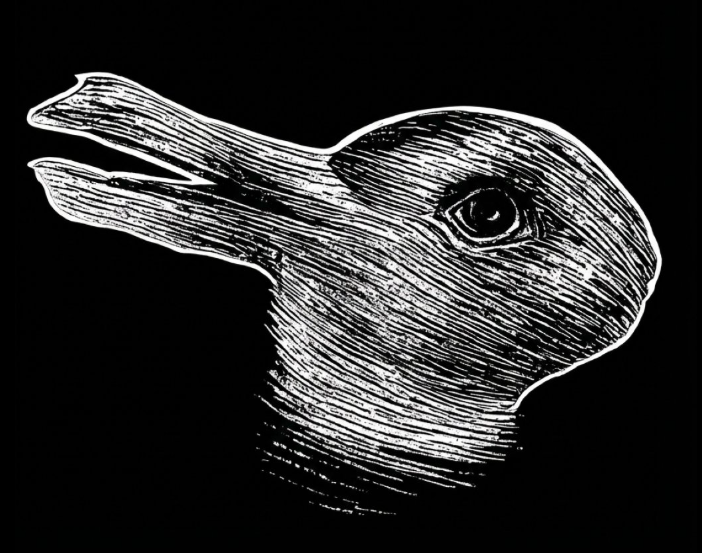
Among the most popular of these illusions are images that conceal two animals within a single drawing. At first glance, most people see only one. The outlines seem clear, the form unmistakable, and the brain quickly locks onto that interpretation. Only after someone points out the second animal does the image suddenly “flip,” revealing another equally valid form hidden in plain sight. This experience can be mildly unsettling, as it challenges confidence in one’s own perception. The design of such images is intentional, using overlapping shapes, shared contours, and strategic negative space to support multiple readings. What matters is not which animal you see, but how decisively you see it. The speed and certainty of that first impression reflect deeper cognitive preferences: whether the mind tends to organize information through structure and definition, or through openness and association.
People who notice one animal immediately are often described as having a practical, detail-oriented approach to thinking. Their brains are skilled at identifying clear boundaries, prioritizing order, and reducing complexity into manageable parts. This style is particularly effective in environments that reward planning, consistency, and logical progression. Such thinkers often excel at tasks that require focus, reliability, and step-by-step problem solving. They may prefer clarity over ambiguity and feel more comfortable when expectations are defined. In perception, this can translate into quickly recognizing the most dominant or conventional shape in an image. The brain selects what feels stable and complete, filtering out conflicting signals to preserve coherence. This does not mean rigidity, but rather an efficiency born from experience: a mind trained to recognize patterns that usually serve it well.
On the other hand, those who first see the alternative animal often display a more intuitive and imaginative mode of processing. Their attention may be drawn to negative space, unusual angles, or less obvious connections. Instead of settling quickly, the mind remains flexible, allowing multiple interpretations to coexist before one emerges. This style of thinking is well suited to creativity, innovation, and abstract problem solving, where possibilities matter as much as conclusions. Such individuals may be more comfortable with uncertainty and more willing to explore ideas that lack immediate structure. In visual perception, this openness allows the brain to notice forms that are less dominant but equally present. The image becomes a playground rather than a puzzle to be solved, and meaning emerges through exploration rather than reduction.
It is important to understand that these interpretations are not labels or fixed traits. Human cognition is dynamic, and most people shift between analytical and intuitive modes depending on context, stress, experience, and goals. A person who thinks structurally at work may think imaginatively in art, relationships, or leisure. The illusion does not diagnose personality, nor does it rank one style above another. Instead, it highlights a tendency, a preference in how attention is deployed when no instructions are given. This is why such visual tests feel personally relevant without being scientifically definitive. They invite reflection rather than judgment. By recognizing how easily the mind commits to a single interpretation, we become more aware of the unseen alternatives we may overlook in daily life.
Ultimately, images like these serve as gentle reminders of cognitive diversity. They show that perception is not a passive act but an active collaboration between the world and the mind. Two people can look at the same situation, the same problem, or the same opportunity and genuinely see different realities, each shaped by valid internal logic. Rather than proving who is right, these differences enrich collective understanding when acknowledged. Visual illusions, though playful and simple, point to a profound truth: seeing is thinking. By becoming curious about how we see, we also become more open to how others do. In a world that often rewards certainty, these moments of perceptual humility remind us that multiple truths can coexist, waiting patiently for us to notice them.