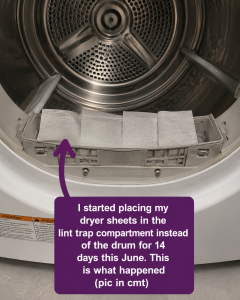
Another benefit involved fragrance distribution. Instead of producing a strong burst of scent when the dryer door was opened, the laundry carried a lighter and more evenly dispersed freshness. The aroma remained noticeable without becoming overwhelming. Individuals who are sensitive to heavily scented products may appreciate this gentler effect, as it leaves clothing smelling clean without saturating fabrics with fragrance.
However, the method was not without drawbacks. While static reduction was impressive, clothing did not feel quite as soft as it typically does when a dryer sheet tumbles freely among the garments. Towels, blankets, and other fabrics that benefit from maximum softness seemed less plush after drying. Additionally, the dryer sheets themselves appeared barely used, creating uncertainty about whether they were being utilized efficiently or simply wasted.
Safety concerns also deserve consideration. Experts warn that placing anything in or near the lint trap could potentially affect airflow. Even minor airflow restrictions may reduce dryer efficiency or create risks if practiced regularly over long periods.
Ultimately, the best solution may be a balanced approach: use the lint-trap method for loads where static control is the priority, and return to traditional dryer-sheet use whenever maximum softness is the desired result.