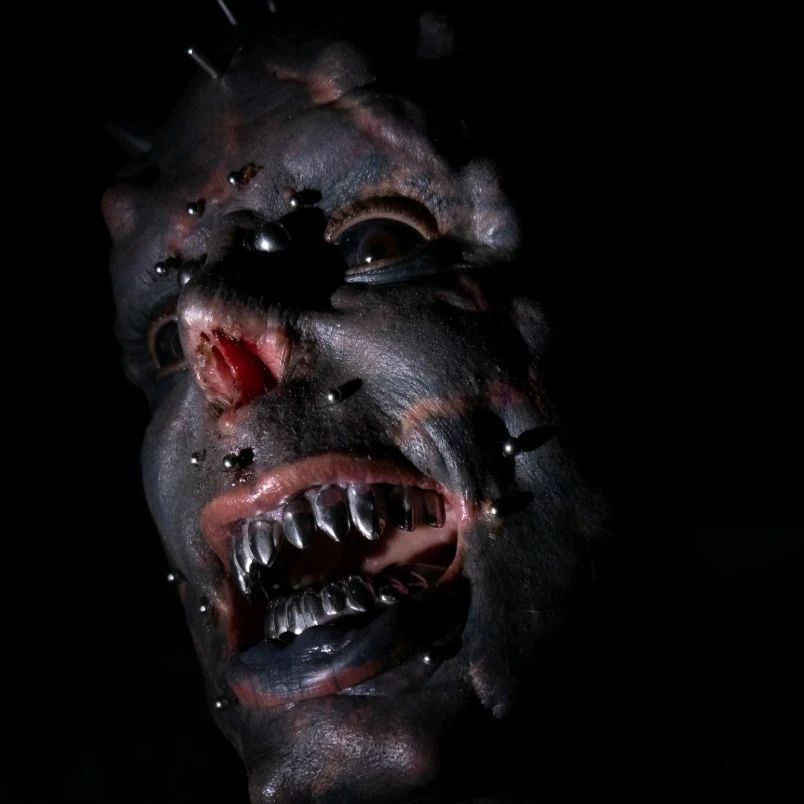
The Extraordinary Story of Diabão Praddo: How a Brazilian Tattoo Artist Became the World’s Most Extreme “Human Satan” Through Decades of Radical Body Modification, Painful Surgeries, and Total Transformation That Continues to Shock and Fascinate Millions in 2025

Michel Praddo, now legally known as Diabão Faro do Prado and globally recognized as “Diabão” or the Human Satan, represents one of the most committed and controversial journeys in the history of extreme body modification. Born in 1975 in Santos, São Paulo, Brazil, this former tattoo artist has dedicated more than two decades to reshaping his entire physical appearance into a living demonic entity that blurs the line between human, art, and myth. With over 80% of his body covered in deep black tattoos, dozens of permanent silicone horn implants on his head (holding a Guinness World Record), completely removed ears, a reduced and reshaped nose, black-tattooed eyeballs, a fully forked and tattooed tongue, bifurcated mouth corners, sharpened fang-like teeth with chrome implants, removed nipples and navel, extensive scarification, and most recently the surgical amputation of multiple fingers on both hands to create claw-like appendages, Diabão has pushed the boundaries of what the human body can endure. His wife, Carol Praddo, known as Mulher Demônia (Demon Woman), has undergone similar modifications to match his aesthetic, creating one of the most visually striking couples in the world. What began as simple tattoos evolved into a lifelong obsession driven by artistic vision, rebellion against societal norms, personal catharsis from a difficult past involving homelessness and addiction, and a desire to become something entirely “other.” Today, at age 50, Diabão continues to evolve, posting graphic updates of his healing processes on social media to his hundreds of thousands of followers. His story raises deep philosophical questions about identity, freedom of expression, mental health, medical ethics, and the fine line between self-actualization and self-destruction. While critics label his modifications as extreme self-mutilation and a cry for help, supporters view him as a bold performance artist and pioneer who lives his truth without compromise in an increasingly conformist world.

The transformation process Diabão has undertaken is nothing short of extraordinary in its scope, duration, and physical toll. It started relatively innocently in the early 2000s when, as a working tattoo artist, he began covering large portions of his skin with solid black ink to create a dark, uniform base. Over the years, this escalated dramatically: he had subdermal implants inserted to form rows of horns across his scalp, removed both external ears completely in 2022 to celebrate the end of COVID mask mandates, reshaped his nose into a more demonic appearance, tattooed the whites of his eyes black (a risky procedure that can cause vision problems), split his tongue into a fork, extended the corners of his mouth through bifurcation surgery, and installed large tusk-like dental implants. One of his most talked-about recent modifications occurred in early 2025, when he amputated the ring and pinky fingers on both hands to create balanced “claws” (which he calls “Las Garras”), documenting the painful healing with graphic photos and videos that garnered millions of views. Each step has involved significant medical risks, including infections, nerve damage, loss of function, and long recovery periods, yet Diabão has repeatedly stated in interviews that the temporary pain is worth achieving his permanent vision. He has also undergone liposuction and abdominoplasty to refine his silhouette. Living with his wife Carol in Praia Grande, Brazil, the couple supports themselves through social media, merchandise, and occasional public appearances. Diabão has openly discussed how his earlier struggles with homelessness and drug addiction fueled his drive for reinvention, viewing his current form as the ultimate expression of overcoming his past and claiming full control over his body and identity.

Beyond the physical changes, Diabão’s journey carries profound psychological, social, and cultural dimensions that have sparked worldwide debate. Many medical professionals and ethicists express concern about the long-term health consequences and question whether such extensive modifications indicate underlying body dysmorphia or other mental health issues. Others celebrate him as a champion of radical self-expression and bodily autonomy in an era where people increasingly modify their appearances through cosmetic surgery, tattoos, and fillers. Diabão himself rejects the idea that he is mentally ill, insisting that his choices are deliberate artistic statements and that he feels more authentic now than ever before. Socially, he and Carol face constant stares, discrimination, and occasional hostility in public, yet they have built a dedicated following in alternative and body modification communities. His legal name change in 2024 to Diabão Faro do Prado marked a symbolic completion of his identity shift, officially severing ties with his former self. Financially, the couple sustains themselves through online platforms where fans pay to follow his progress, buy custom artwork, or purchase branded items. Culturally, Diabão has become a symbol in Brazil and internationally of pushing against conservative beauty standards and religious taboos, especially given his demonic aesthetic in a predominantly Catholic country. His story has been covered by major outlets like Reuters, the New York Post, and the Daily Mail, turning him into a viral internet phenomenon that continues to generate strong reactions ranging from admiration to horror.

The couple’s shared lifestyle with Carol (Mulher Demônia) adds another fascinating layer to this narrative, as they function as true partners in transformation. Carol has also undergone extensive blackwork tattoos, facial modifications, implants, and other procedures to complement Diabão’s look, creating a unified demonic aesthetic that they proudly display together at beaches, events, and in photoshoots. Their relationship appears deeply bonded by mutual understanding and acceptance of this extreme lifestyle that most conventional partners would never comprehend. Diabão frequently credits Carol as his muse and supporter through the most painful procedures. Together, they challenge traditional notions of marriage, beauty, and partnership, living as walking embodiments of their dark artistic vision. Despite the controversies, they maintain a relatively private home life in coastal Brazil, occasionally sharing glimpses into their daily routines that humanize them beyond the shocking visuals. Diabão has spoken about wanting to inspire others to break free from societal expectations and embrace their true selves, no matter how unconventional. However, he also acknowledges the isolation that comes with such extreme choices, including strained family relationships and limitations in employment outside of his modification-related income streams. As of 2025, he shows no signs of slowing down, hinting at future procedures that could push the boundaries even further.

Public reaction to Diabão’s transformation has been intensely polarized since he first gained international attention around 2021. Supporters in the body modification subculture hail him as a pioneer and hero of self-expression, drawing parallels to historical figures who modified their bodies for cultural or spiritual reasons. Detractors, including some medical experts and religious groups, condemn his actions as dangerous self-harm that glorifies mutilation and could encourage vulnerable young people to make irreversible decisions. Online platforms amplify both sides, with his Instagram posts regularly receiving millions of views and thousands of comments that range from supportive to deeply offensive. Despite this, Diabão remains remarkably resilient, often responding to criticism with calm philosophical statements about personal freedom and the temporary nature of physical form. His story has inspired documentaries, YouTube deep dives, and countless articles exploring the psychology of extreme modification. In many ways, he has become a modern myth — the man who willingly became the devil in the eyes of society to find inner peace. As medical technology advances and societal attitudes toward body autonomy continue to evolve, cases like Diabão’s will likely fuel ongoing debates about where personal freedom ends and societal responsibility begins.

Looking toward the future, Diabão Praddo shows every intention of continuing his evolution well into the coming years, solidifying his place as one of the most committed body modification enthusiasts alive today. At 50 years old, he remains active on social media, sharing updates about healing from his latest finger amputations and teasing potential new projects that could include additional implants or refinements. His journey serves as a powerful case study in human determination, the search for identity, and the extremes some individuals will endure to feel whole. Whether viewed as a cautionary tale, a work of living art, or a profound act of rebellion, Diabão’s story forces us all to confront uncomfortable questions about our own relationships with our bodies and the lengths we might go to express our inner truths. In a world that often pressures people to fit into neat categories, his unapologetic transformation stands as a radical reminder that some choose to rewrite the rules entirely. Through pain, sacrifice, and unwavering commitment, the Brazilian Human Satan has created a legacy that will continue to provoke, inspire, and unsettle generations to come.

Human Satan before body modifications

Diabão” e mulher-gato: 5 pessoas que cansaram de ser humanos | Web Stories  CNN Brasil

PHOTOS: Brazilian tattoo artist Michel Praddo, also known as Diabao or Human  Satan, and his wife Carol Praddo, known as Mulher Demonia or Demon Woman,  are quite special…in their own very unique


Tattooed 'Human Satan' addicted to body modifications has two fingers  removed to give himself alien-style claw | Daily Mail Online

Related Posts

The Unexpected Reunion: Sixteen Year Old Emma’s Act of Kindness Buying Sneakers for Poor Classmate Caleb with Her Saved Money Brings Her Presumed Dead Father Back to the School Where He Awaits Her Mother Shocking Everyone and Leading to an Emotional Family Healing That Shows the Power of Compassion and Belief in Goodness Even After Loss

I screamed, “WHAT ARE YOU DOING HERE?! THIS CAN’T BE REAL!” as my knees buckled and the world tilted sideways in the cramped principal’s office, the fluorescent…

Which U.S. States Could Be Most Impacted in a Major Global Conflict and Why Security Analysts Often Point to Eight Key Locations Where Military Bases, Strategic Missile Fields, Naval Fleets, Defense Industries, and Critical Command Centers Could Make Them High-Priority Targets During the Early Stages of a Hypothetical Large-Scale War

In an era marked by rising geopolitical tensions, discussions about global conflict have reentered public conversation in ways that many people once believed belonged only to the…

When My Parents Chose a Luxury Trip Over My Wedding Day, I Faced Heartbreak Alone—Until My Father-in-Law Stepped Forward, Took My Hand, and Walked Me Down the Aisle, Creating a Powerful Moment of Love, Loyalty, and Belonging That Touched Millions and Redefined What Family Truly Means

On the morning of my wedding, my phone lit up—not with a message of love, but with a photo. My mother, relaxed in business class, smiled behind…

Discover the 10 early signs of dementia you should never ignore including memory loss that disrupts daily life challenges in planning or solving problems difficulty completing familiar tasks confusion with time or place trouble understanding visual images and spatial relationships new problems with words misplacing things poor judgment withdrawal from social activities changes in mood and personality essential guide for early detection and brain health

Memory loss that disrupts daily life stands as one of the most common and recognizable early signs of dementia, particularly Alzheimer’s disease. Unlike typical age-related forgetfulness where…

I Opened My Teen Daughter’s Bedroom Door Expecting the Worst—But What I Discovered Behind It Changed How I See Trust, Parenting, and the Quiet Strength Growing Inside Today’s Teenagers in Ways I Never Imagined Possible

I Opened My Teen Daughter’s Bedroom Door Expecting the Worst—But What I Discovered Behind It Changed How I See Trust, Parenting, and the Quiet Strength Growing Inside…

THE FAMILY PHOTO SEEN AROUND THE WORLD: HOW A SINGLE SNAPSHOT OF DONALD TRUMP’S CHILDREN — AND ONE “DISTRACTING” DETAIL AT THE EDGE OF THE FRAME — SENT SOCIAL MEDIA INTO A FRENZY, SPARKED HEIGHT TRENDING SEARCHES, AND SHIFTED ATTENTION AWAY FROM THE STATE OF THE UNION SPEECH

On February 24, 2026, hours before President Donald Trump delivered what would become the longest State of the Union address in modern U.S. history, the internet found…