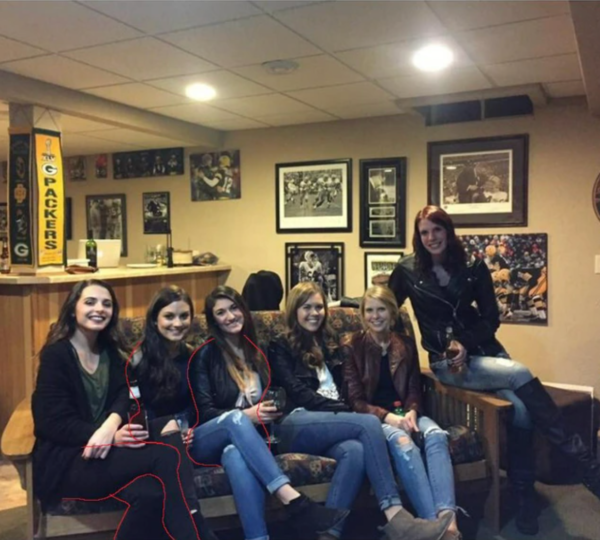
Optical illusions are captivating because they expose the fascinating ways our brains interpret, misinterpret, and sometimes outright misread visual information. Even the sharpest observers can pause, question what they see, and wonder how their own eyes might be deceiving them. Recently, one particular illusion has captured attention across social media: a photograph featuring six girls sitting on a couch, yet appearing to show only five pairs of legs. The image is simple, yet it baffles viewers, sparking debates, theories, and attempts to reconstruct what’s happening in the frame. For those unfamiliar with the mechanisms behind optical illusions, this image provides an ideal demonstration of how perspective, positioning, and subtle visual cues can create a scenario where the brain fills in gaps or makes incorrect assumptions.
Understanding why illusions like this work requires a look at how humans process visual input. According to the Queensland Brain Institute, an optical illusion occurs when the brain and eyes attempt to communicate but the interpretation becomes “mixed-up.” Essentially, our brains continuously interpret cues, predict patterns, and fill in missing information. These processes are usually seamless, allowing us to navigate the world efficiently. However, illusions exploit these shortcuts, tricking the brain into seeing something that isn’t there or misassigning visible elements. This capacity evolved as a survival mechanism: heightened sensitivity to movement and pattern recognition helped humans detect predators or other threats in prehistoric environments. In controlled or artificial settings, like photographs, these same survival mechanisms can produce baffling visual phenomena that seem impossible at first glance. Shadows, overlapping objects, and ambiguous perspectives are all common techniques that manipulate the brain’s natural assumptions, creating striking illusions that challenge our perception.
The viral six-girls photograph illustrates these principles perfectly. At first glance, it appears that one girl has no legs, yet careful observation reveals that all limbs are present but cleverly obscured. Social media users initially speculated about Photoshop errors or intentional pranks, while others meticulously analyzed the positions of each girl, clothing details, and limb placement. The illusion arises primarily from the strategic overlapping of legs and the use of perspective. For instance, one girl’s legs may be hidden behind another’s, while crossed legs, torn knees, or mismatched socks serve as subtle cues that help viewers eventually decode the image. Reddit users have even created diagrams explaining the precise positions, showing how the “missing” legs are in plain sight but visually misassigned. The brain, seeing a complex tangle of limbs, simplifies the information incorrectly, producing the impression that a girl is legless.
Several factors contributed to this illusion’s viral success. First, its relatability: most people enjoy puzzles and the challenge of spotting hidden elements, making it easy to share and discuss. Second, the illusion is complex enough to be intriguing but not so convoluted that it feels unsolvable, encouraging engagement and repeated examination. Third, social media platforms such as Reddit and Twitter amplify collective problem-solving, with comments, diagrams, and theories fueling further interaction. Beyond entertainment, this image underscores the limits of human perception, highlighting how easily assumptions can mislead even the most attentive observers. It reminds us that what we see is often a construct of our brain’s interpretive processes, not a perfect reflection of reality.
To solve illusions like this, viewers can use a systematic approach. First, look for overlapping limbs and subtle visual cues such as torn knees, socks, and shoes. Second, observe perspective carefully, noting which figures are leaning, which are obscured, and how shadows fall. Third, focus on details that might separate one person’s limbs from another’s, such as the direction of a foot or a slight bend in a knee. With careful analysis, the mystery resolves, revealing that no legs are truly missing and the brain’s initial interpretation was simply a misassignment. This process demonstrates how observation, attention to detail, and patience can overcome perceptual errors and shows how easily our minds can be fooled by context and arrangement.
Optical illusions like this offer more than amusement—they reveal the complexity and adaptability of the human brain. They illustrate how perception is shaped by assumptions, experience, and evolutionary wiring, and they encourage playful engagement with visual information. Beyond entertainment, they provide insight into cognitive processes, showing how our minds construct reality from fragmented input. Sharing and solving illusions fosters curiosity, social interaction, and problem-solving skills, making them both fun and educational. The six-girls-on-a-couch image reminds us that perception is rarely absolute, and small changes in perspective, framing, or context can dramatically alter what we believe we see. In the end, illusions challenge our confidence in our senses, offering a humbling yet rewarding glimpse into the inner workings of human cognition and perception.